
How to Get Better at Games Without Playing All Day
Use focused practice, clear goals and short review sessions to improve gaming skills without committing excessive amounts of time.
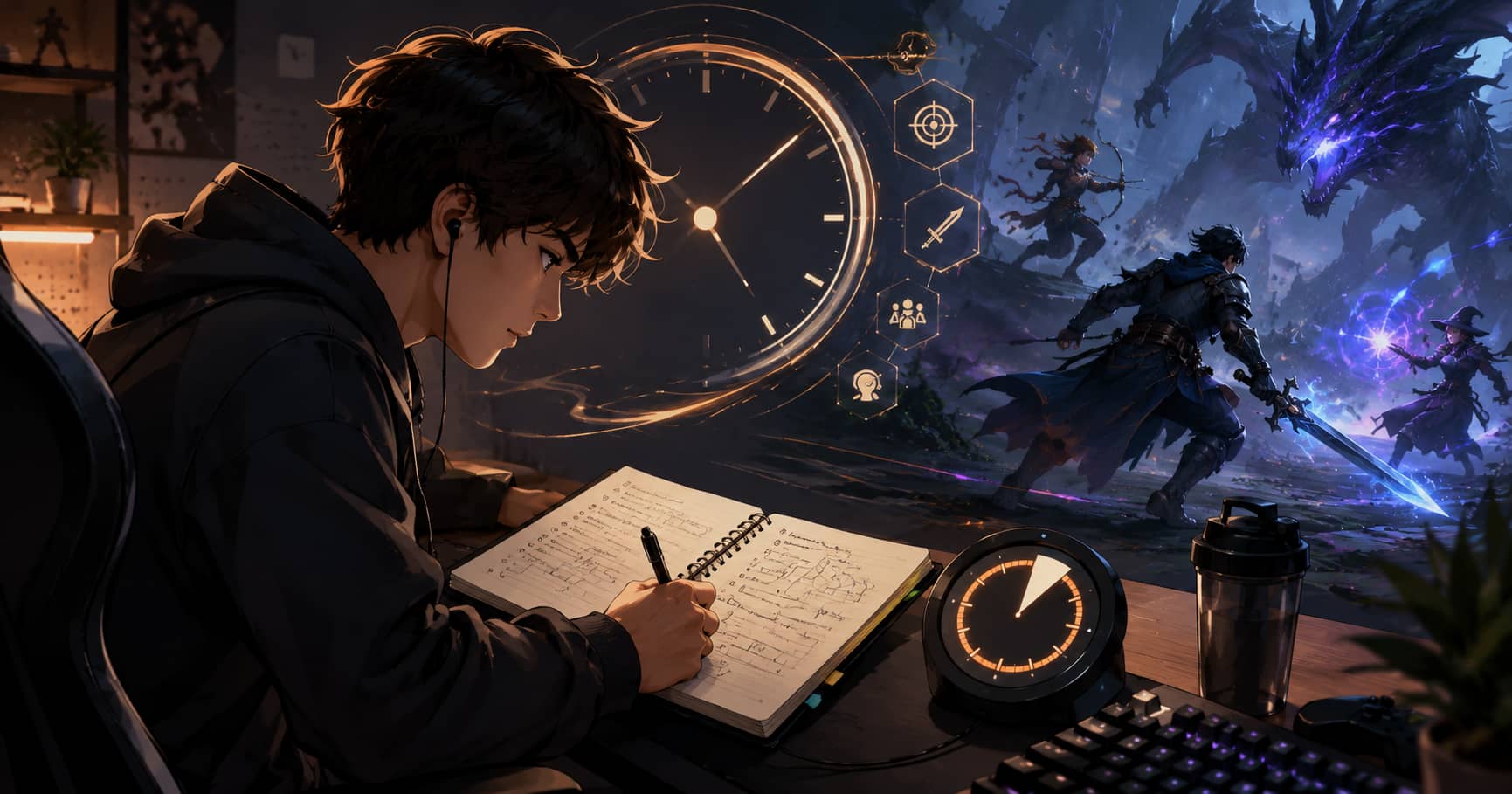
More hours can produce more experience, but unstructured repetition also reinforces bad habits. Players with limited time improve faster when each session has a narrow purpose, immediate feedback, and a clear stopping point. The goal is not to turn leisure into unpaid training. It is to spend less of your available time repeating the same mistake.
Research using large online-game datasets has suggested that practice spacing and early session structure matter. A Brown University summary of studies on how players acquire game skill reported that moderate, spaced practice could be more efficient than compressed play. That does not mean there is one perfect schedule, but it supports a practical principle: quality and recovery matter alongside volume.
Define one skill that can be observed
“Get better” is too vague. Choose a behaviour you can see and repeat: checking the minimap before entering a fight, keeping the crosshair at likely head height, using defensive abilities before health becomes critical, planning two turns ahead, or completing a platforming section without rushing.
Use one focus for several sessions. If you try to improve aim, positioning, resource management, communication, and advanced techniques simultaneously, every mistake has a different explanation. A narrow target makes feedback clearer.
Warm up with the mechanic you intend to use
A useful warm-up resembles the real task. Five minutes of random movement is less valuable than rehearsing the exact shot, route, combo, build order, or defensive timing that caused trouble. Use a training mode, low-risk encounter, replayable challenge, or custom match.
Stop the warm-up when control feels reliable. Endless warm-up can become avoidance. The objective is to enter real play prepared, not to achieve a perfect practice score.
Separate decisions from execution
When reviewing a failure, ask whether the idea was wrong or the execution failed. Choosing an exposed route is a decision problem. Missing a well-prepared shot is an execution problem. The solutions differ: decision errors need better information and planning; execution errors need focused repetition.
This distinction prevents endless mechanical practice when positioning is the real weakness. It also prevents blaming strategy when a control setting makes precise input difficult. Review our list of settings to adjust before starting a game if sensitivity, visibility, or button layout repeatedly interferes.
Use short feedback loops
After a match, run, or level, identify one event that changed the result. What information was available? What choice did you make? What would a better choice look like next time? Write one sentence if necessary. Avoid reviewing every second of play unless you are working at a competitive level and have a specific question.
Video replay is useful because memory is selective. Record a short section around the mistake, not hours of footage. Watch once at normal speed and once slowly. Look at your camera, resources, map information, and timing before focusing on the final error.
Practice under slightly easier conditions
If a task fails almost every time, the practice may be too difficult to produce useful repetition. Reduce speed, lower enemy pressure, use a simpler character, or isolate part of the sequence. Once the movement is reliable, restore normal conditions.
This is not the same as avoiding challenge. Good practice sits near the edge of current ability, where mistakes happen but success remains understandable. Repeated failure without diagnosis mostly trains frustration.
Build a small library of reliable choices
Beginners often copy complex professional strategies that depend on exceptional execution and team coordination. Start with a smaller set of dependable options: one main character, two weapon types, a basic opening, or a few safe routes. Familiarity frees attention for reading the game.
Add variety after the foundation works. A limited toolkit is not a permanent identity; it is a way to reduce decision load while learning fundamentals.
Protect attention and recovery
Improvement drops when fatigue makes every decision slower and every loss more emotional. Use a session limit or stop condition, such as three ranked matches, two focused runs, or forty-five minutes. Take a brief movement and vision break between blocks.
Do not use a losing streak as a reason to extend the session indefinitely. If you cannot identify what you are practising, switch to casual play or stop. Sleep and time away help consolidate learning, while exhausted repetition often produces careless habits.
Measure behaviours, not only rank
Rank and win rate are delayed outcomes influenced by teammates, opponents, matchmaking, and sample size. Track behaviours that you control. Did you check available information before acting? Did you use the planned defensive tool? Did you complete the opening without wasting resources?
A small improvement in a repeatable behaviour can precede any visible rank change. This keeps progress honest without making every session dependent on victory.
Keep the game enjoyable
You are allowed to play without practising. Separate focused sessions from relaxed sessions so the hobby does not become a permanent performance review. A player who enjoys returning regularly is more likely to improve than one who forces long sessions and quits.
The efficient pattern is simple: choose one skill, rehearse it briefly, apply it in real play, review one meaningful moment, and stop while attention remains useful. Limited time is not a barrier when each session gives you information you can use in the next one.
GameAtlas HQ
Read more practical gaming coverage across our six editorial categories.